

|
Survival of the Fittest By Chris McKenna The strong and big takes the lower position, the supple and weak takes the higher. -- Lao Tzu NAGQU, China, Sept. 15 -- Twenty-five centuries ago, Taoism's founder advised the people of China to present a meek, pliant exterior while maintaining a disciplined, steely interior. The rationale: weakness and suppleness are qualities of the living, while hardness and stiffness signify death. Hermann "the German" Layher, and the British team of Francesca Sternberg and Jennifer Gillies, show that this bit of wisdom applies to 20th century road rallies as well. Hermann was last seen in Golmud, sitting numbly in a chair, still suffering the effects of hypothermia, his face a purple hue, a bandage across his nose. "I just want to be in bed," he said, but clearly was not sure how to go about getting there. Then Layher's assistant, Mark Klabin, spread the word: Hermann would not go on. With the beginnings of pneumonia and severe altitude sickness, Hermann could not brave the frigid Tibetan plateau in his open-air La France.
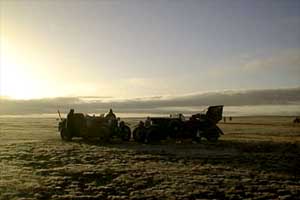 The Bentley teams defrost before another day on the road. Roaring down the road well beyond the recommended speed, poorly dressed for eight hours exposure to ice-cold rain, and at times a wee hung over, Hermann was a wonderful sight on the roads of China, but a tad short-sighted. He confessed as much after he was found babbling half-naked in a Tibetan nomad's yurt. "I made three mistakes: I drive too hard, make too much parties, and did not have proper clothes for the weather." Added Klabin, who had been working in Hermann's unofficial support vehicle: "The car was running beautifully. It was the mental weakness of the driver." Where Hermann was noisy, brash and theatrical, Francesca and Jennifer are subtle, steady and quietly determined. They spent a long Saturday night in Golmud having the shock absorbers reinforced on their 1964 Volvo Amazon. The shocks have been a constant problem since Beijing. "We drive all day and then spend five hours a night working on 'Gordon' (the car's pet name)," says Jennifer, munching on bakery rolls, which constitute her first meal in 24 hours. "On rest days we spend the whole day at the garage." Francesca was dining on a combination of cold medication and altitude-sickness pills buffered by anything she could find to stay awake.
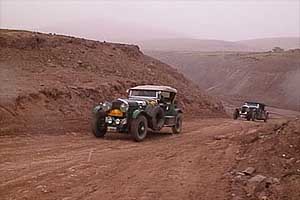 Riding conditions varied from dirt to snow. Before Beijing, neither Jennifer nor Francesca had any motoring experience. But after deciding to enter the rally 2 1/2 years ago, they selected the '64 Volvo Amazon after flipping through an I Spy classic car paperback series and consulting a mechanic. They have since learned to take their Amazon apart, have studied road rally rules and procedures, and have even learned a bit of Tibetan. The Golmud mechanic's job carried Jennifer and Francesca yesterday along the 16,500-foot "Roof of the World," the highway between Golmud and the next stop on the route, Tuotuoheyan. The road lived up to its name, an empty expanse studded by the breathtaking Kunlun mountain range, snow-covered year round. Through much of the stretch there was little wildlife, aside from an occasional circling eagle or buzzard. The scene grew bleaker as the drivers neared the Tuotuoheyan military settlement where we camped last night. Icy sleet began to fall as the drivers tried to navigate a series of treacherous detours. Black-faced road workers looked on as half of the cars struggled through and up the sides of the muddy ravines.
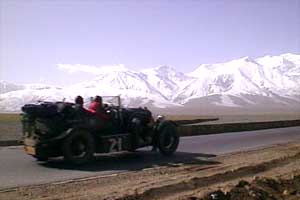 Adam Hartley and Jonathan Turner in their '29 Bentley Not a few cars got stuck and had to be pushed up the incline, gasping in the oxygen-thin air. Jennifer and Francesca, however, bounced cautiously through. "Gordon was good," Francesca said. This morning was grim for many of the altitude-sick drivers after a night when temperatures fell below zero. The day began with a climb up to the highest road in the world, the Tanggu La, at nearly 17,000 feet. From there, it was down into Amdo, the junction of the main highway to western Tibet.
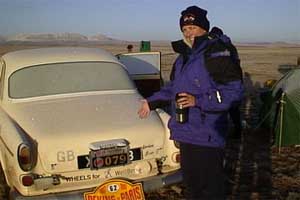 Francesca Sternberg and "Gordon" defrost after a night of freezing weather. After the desolation of previous days it was Shangri La. Shaggy yaks grazed on rolling green pastures, their dreadlocked fur hanging in clumps as they nimbly bobbed about. Shepherdesses wearing orange and pink scarves followed their fluffy charges, who from a distance looked like puffed rice on the hillside. Farm workers puttered by on ubiquitous motorized tricycles, their back carts packed with laborers wearing eye-popping shades of red, green, purple and pink, which complimented their dark skin and wind-chafed cheeks. It was a marvelous day with a familiar footnote: The '64 Volvo Amazon lost another shock absorber, this time from his rear. Jennifer replaced it herself. "The learning curve on this trip for both of us has been a vertical line," says Francesca. "Over the past few days it's gone off the chart."
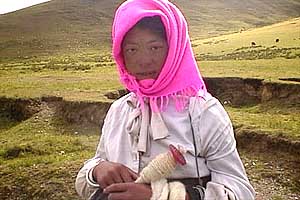 A young shepherdess spins sheep wool into yarn while tending her flock. Pictures (from top right): Brown Brothers | Popperfoto/Archive Photos | Auburn Museum/Archive Photos | Chris McKenna/Candide Media Works | Copyright © 1997 Discovery Communications, Inc. |