

|
Captain Zen By Chris McKenna XEGER, Tibet, Sept. 19 -- At age 75, John O'Neill is living his second childhood. While most motorists are bolting across the rut-filled, dusty roads, accelerating to make tighter deadlines just imposed by rally marshals, the event's oldest entrant is blissfully bouncing along in his 1960 Volkswagen Cabriolet, playing "Shave and a Haircut, Two Bits" on his horn, and gazing at the valleys in childlike wonder. "I don't believe in God, I believe in this," says O'Neill, gesturing out the window at central Tibet: rippling golden fields of wheat, a clear turquoise sky, fluffy clouds casting shadows on the surrounding mountains, Everest looming to the southwest. "This is my God, this land, these people."
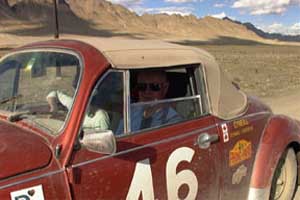 John O'Neill and his VW meander through Tibet. O'Neill was convinced to enter the rally by another competitor, his Greek son-in-law Thacos Tsicrycas. "He thought I was too young at age 75 to be sitting home," says O'Neill, a retired captain in the Canadian army. O'Neill had been driving with his daughter, Susan Tsicrycas, but she got the flu after several chilly nights camping and decided to fly with her husband to Katmandu. Rally rules prohibit competitors from driving alone and, in order to win, the teams must remain together the entire route. As a result, O'Neill has been demoted to the non-competitive touring class and is taking in strays, driving each day with a different volunteer. None of this appears to faze him: "I'm just happy to be driving and looking out the window." Not all of the drivers have such a Zen-like approach to the rally. Many serious drivers have been grumbling because the route has not allowed them to separate themselves from the novices. Despite rally organizers' warnings that Tibet would prove too difficult for dozens of cars, only eight of the 94 drivers had officially retired by the time the race reached the Tibetan capital of Lhasa. And 25 drivers were tied for first place, having punctually reached all of the daily time stages.
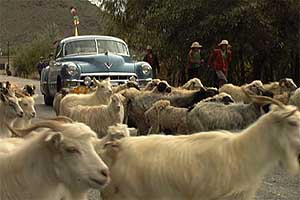 Sheep and goats are just a few things keeping the pace of the rally slower than expected. Clearly, the route has not been as treacherous as projected. In fact, the high pass from Lhasa, which was expected to knock some motorists down in the ranking, was deemed too dangerous to travel, and the rally instead took an alternate route through the lowlands. To compensate, route coordinator Mike Sommerfield decided to limit the time drivers can lag between checkpoints, essentially increasing the average speed of the classic cars from 34 mph to about 43 mph. After the first day of the new times, the number of drivers tied for first place had fallen to seven. Again, there were grumbles, this time from those who couldn't keep up the pace. "If you're in this to win, you bring a car that will win," responded Sommerfield. "If you're not, you use your head." As he navigates the kidney-shaking dips and soot-faced urchins begging for money on the road up the 17,226-foot Gyatso Pass, O'Neill calls on his 36 years experience as an infantryman. "Left then right, left then right," he repeats to himself. "That's the way we always did it." All along, he pats the VW's creamy leather dashboard, encouraging her not to stall on the incline. "Steady baby, steady baby." He's equally compassionate with the road workers and beasts of burden: To a woman shoveling mud on the side of the road -- "Oh it hurts to see you doing that mother." To the donkey limping painfully along with a mangled hoof -- "Oh, put the beast out of its misery. If I had a gun I would, but then I would probably be charged." To the hungry, filthy children who swarm the car, grabbing at water bottles, hawking small fossils -- "Give 'em medical, give 'em dental care and leave them alone. Maybe they will thrive without their culture being destroyed." And even to the authorities -- "Is that the police behind us? Well bless their hearts."
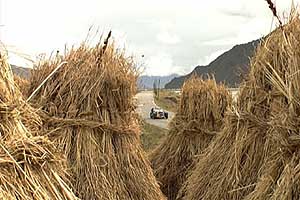 Hay stacks along the rally route in Tibet O'Neill is uncharacteristically chatty during the 10-hour trip, talking about things he normally won't discuss, like what it was like watching the bombing of the French town of Caen after landing at the Normandy beaches in World War II. O'Neill joined the Royal Canadian Regiment when he was 17. "I was lonely, big and tall," he says, "and my uncle was a sergeant so he encouraged me to enlist." After serving in World War II, the Korean War and in the Golan Heights, he retired at age 56 and settled down in Palmerston, a two-policeman town 90 miles from Toronto, where the mayor runs the general store.
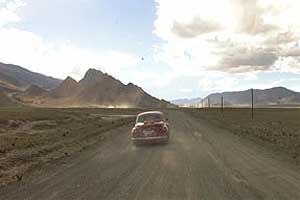 "Zen" O'Neill kicks up a little dust. Comfortably ensconced in small town life, O'Neill still burns to travel. And
neither freezing rains nor sweltering deserts concern him. "I'm cremation
material," he says. "I don't believe in life after death, so I'm making the most
of my life on earth. Pictures (from top right): Brown Brothers | Popperfoto/Archive Photos | Auburn Museum/Archive Photos | Drew Fellman/Candide Media Works | Copyright © 1997 Discovery Communications, Inc. |