Greetings class,
As yesterday was a holiday, I am posting this week’s lecture today. Today we are going to focus on the history of the black press. But first, this week in the news.
TRUMP’S TAXES
The NYTimes has posted a series of articles on President Trump’s taxes, after years of seeking to have them released.
NYTimes: Long-Concealed Records Show Trump’s Chronic Losses and Years of Tax Avoidance
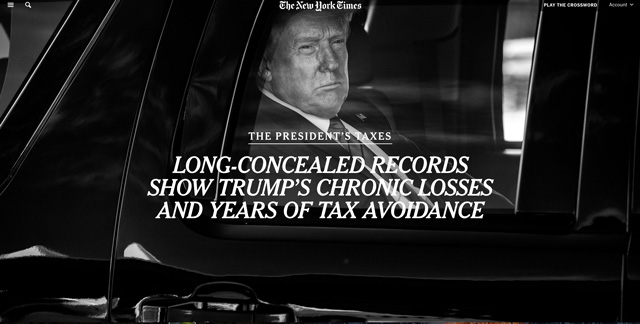
Trump Taxes
The Times concludes:
– Donald J. Trump paid $750 in federal income taxes the year he won the presidency. In his first year in the White House, he paid another $750.
-He had paid no income taxes at all in 10 of the previous 15 years — largely because he reported losing much more money than he made.
– Ultimately, Mr. Trump has been more successful playing a business mogul than being one in real life.
– The red ink spilled from everywhere, even as American television audiences saw him as a savvy business mogul with the Midas touch.
– Mr. Trump’s genius, it turned out, wasn’t running a company. It was making himself famous — Trump-scale famous — and monetizing that fame.
— NYTimes
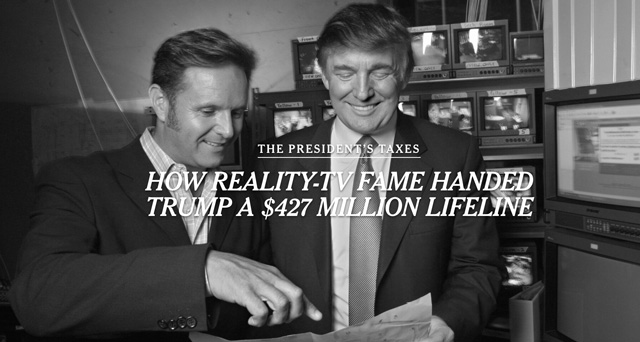
Anonymous Source
The Times also explains it got the information from an anonymous source which it won’t reveal and also details why it believes the American people have the right to know this .
“We are not making the records themselves public because we do not want to jeopardize our sources, who have taken enormous personal risks to help inform the public.
As a candidate and as president, Mr. Trump has said he wanted to make his tax returns public, but he has never done so. In fact, he has fought relentlessly to hide them from public view and has falsely asserted that he could not release them because he was being audited by the Internal Revenue Service. More recently, Mr. Trump and the Justice Department have fought subpoenas from congressional and New York State investigators seeking his taxes and other financial records.
Our latest findings build on our previous reporting about the president’s finances. The records show a significant gap between what Mr. Trump has said to the public and what he has disclosed to federal tax authorities over many years. They also underscore why citizens would want to know about their president’s finances: Mr. Trump’s businesses appear to have benefited from his position, and his far-flung holdings have created potential conflicts between his own financial interests and the nation’s diplomatic interests.”
— NYTimes
Stressed Election
The Times also produced a revealing story “Why Voting in This U.S. Election Will Not Be Equal”
It is the first episode in a four-part series, and focuses on voter suppression in Georgia, where a growing Black and Latino population may face extra hurdles on election day. It is an eye-opening piece which shows some of the specific techniques used to suppress voting by specific populations. Please watch. It is fairly short (15 minutes.)
To Plead Our Own Cause
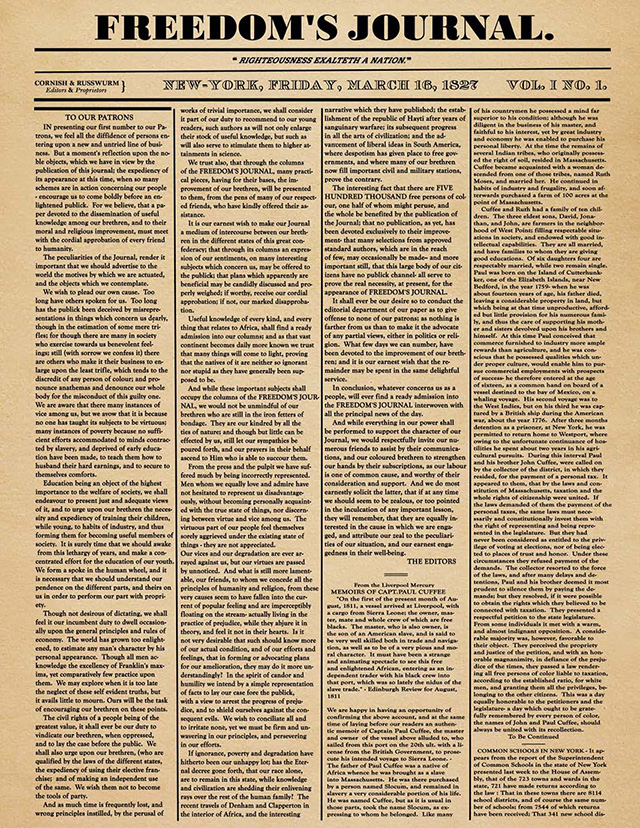
The first African-American owned and operated newspaper in the U.S.
This week’s reading focuses on the history of the black press and why it is so essential that the news be covered from all perspectives if it is to be an accurate reflection of reality.
A few highlights:
– Freedom’s Journal was the first black-owned newspaper in America, the beginning of a new opposition press for the nation. It spawned an independent communications network among black freedmen.
– The founders say in the first issue, “From the press and the pulpit we have suffered much by being incorrectly represented.”
– They also spoke out about what they saw as an effort of other newspapers to “excite hostile feelings, between the lower classes of the white population, and the people of colour.”
– Freedom’s Journal provided the first public forum for blacks to debate among themselves strategies for their own liberation.
– The Colored American was an uncompromising advocate for the citizenship rights of black New Yorkers. The paper sharply criticized the lack of standards in the mainstream press. It also criticized what it viewed as an obsession with revenues.
– A second generation of black editors and publishers began to emerge in the North in the 1840s. The submissive manner of the first generation of middle class journalists changed with the second, a group that included Frederick Douglass, Henry Highland Garnet, Martin Delany and David Ruggles. Some were one-time slaves and were largely self-educated. They harbored no illusions about the hostility they faced from white America.
– These black editors sought to organize and to give voice to a two-pronged freedom struggle; against slavery in the South and for full citizenship in the North.
– A series of black conventions that occurred before the Civil War were historic gatherings where black leaders openly debated the most effective methods and tactics to achieve their freedom in America. Black editors publicized those gatherings in their papers, they participated actively in the debates among the delegates, and they reprinted the key speeches and resolutions.
– Those early black editors and the national convention movement they helped initiate shaped the seminal differences in outlook and strategy that still exist in African-American society — between assimilation and separation, between moral reform and militant rebellion, between arousing the masses of oppressed blacks to achieve full equality or depending on the talent and economic progress of the middle class to lift the entire population into citizenship.
– Frederick Douglass, who would eventually edit six different newspapers, towered over all of his colleagues in both the power of his writing and the influence of his publications. Douglass was an outspoken advocate of women’s rights. He attended the July 1848 Seneca Falls convention that launched the modern feminist movement and signed its declaration.
– Douglass condemned the US war against Mexico as an act of aggression and boldly asserted the conflict was fueled by racial prejudice toward the Mexican people. As the most influential black editor of the nineteenth century, Douglass made opposition to empire an acceptable view among black journalists.
BLACK JOURNAL 1968-1977
In an August issue of the New Yorker, Doreen St. Félix wrote For Us, By US, about rewatching “Black Journal,” a news magazine television show five decades after it aired.
New Yorker:
In July 59 episodes of the public-affairs magazine show “Black Journal” became available to stream, for the first time, as part of the American Archive of Public Broadcasting. “Black Journal” was a news program “about Blacks and for Blacks” — one that abandoned the euphemistic notion of the “Black community,” restoring to the people a sense of their variety. The virtue we call soul — “Black Journal” embodied it.
Originally a monthly, hour-long show, “Black Journal” was part of a small explosion of Black radio and television that emerged at the end of the sixties, partly in response to the recommendations of the Kerner Commission, a 1967 investigation, launched by Lyndon Johnson and led by the governor of Illinois, Otto Kerner, Jr., into the causes of the race riots. “What white Americans have never fully understood but what the Negro can never forget—is that white society is deeply implicated in the ghetto,” the report’s introduction read.
The Kerner Commission denounced police brutality and voter suppression—and the media, for reporting “from
the standpoint of a white man’s world.” Black media-makers put technology in the service of furthering the good word of Black liberation politics. The titles of the new shows that sprang up around the country conveyed an ethos of frank talk: “Say Brother,” “Like It Is,” “Positively Black.”
In the première of “Black Journal,” the presenter Lou House delivers a short monologue on the history of the Black free press. But the episode is decidedly of its time, which was, like ours, one of transformation, violent and hopeful by turns. It opens with footage of Coretta Scott King as she addresses the Harvard class of ’68, a new widow urging young people to protect their future. The Ebony journalist Ponchitta Pierce, acting as correspondent, invokes the decade’s dilemma: “Will their search be for middle-class detachment or insightful involvement?”
— New Yorker
Please watch some of the program. I realize it is fairly long. You can jump around if you want but I recommend you try and watch at least a short bit of most segments to get a sense of program’s variety. Note: The last segment is a very derogatory satire. The language and dialogue is offensive and racist. I believe that is part of the producers’ point. However, you can skip it if you’d rather not watch.
ASSIGNMENT
Read: News for All the People, Chapter 7 – To Plead Our Own Cause (PDF in the Week to Week folder.)
Read: CJR: We Wish to Plead Our Own Cause
Discussion Board: After reading the CJR piece, in 250 words, explain what the example of Clarksville showed about the limits of some civil rights legislation in the town and the ability of the white press to cover the story.