Basic Rules of Thumb for Photo Usage
1) You should assume that all images you find online are copyrighted unless it is explicitly stated that they are in the public domain or that the creator/owner has given permission for public usage. (More on this below.)
2) Many news organizations contract with photo agencies for online images and you will see these credits on media sites: AP, AFP, Getty, Reuters, etc. It is NOT OKAY to take these images and use them on your site unless you are paying for that option. You do have access to an AP photo bank through the school.
3) Most images created by federal agencies will fall into the public domain category. However, you should take care to read any disclaimers or exceptions that might be posted on individual sites.
Photos Portals
1) flickr.com
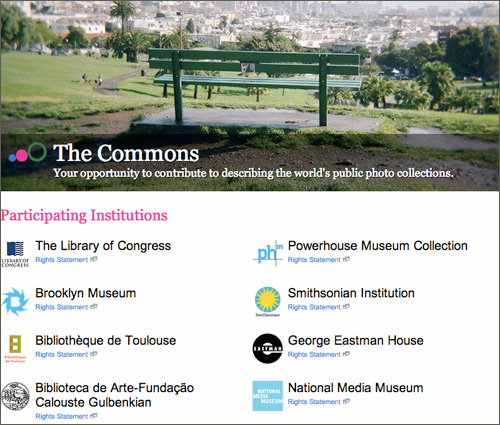
– The Commons
A growing collection of public domain photography from a range of national and international institutions, including the Library of Congress, the New York Public Library, NASA, The U.S. National Archives, Smithsonian Institution, The National Archives UK, and Bibliothèque de Toulouse.
Example: 1903 images of the Bronx zoo
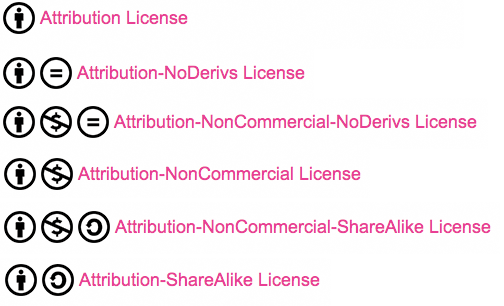
– Creative Commons on Flickr offers work by members that is available for use. You can search by varying degrees of copyright.
Attribution: You let others copy, distribute, display, and perform your copyrighted work – and derivative works based upon it – but only if they give you credit.
Example: Search for the word “dream”
Noncommercial: You let others copy, distribute, display, and perform your work – and derivative works based upon it – but for noncommercial purposes only.
Example: Search for the word “UFO”
Example: Search for “street art”
No Derivative Works: You let others copy, distribute, display, and perform only verbatim copies of your work, not derivative works based upon it.
Example: Search for “Grand Concourse”
Share Alike: You allow others to distribute derivative works only under a license identical to the license that governs your work.
Example: Search for subways around the world
2) CreativeCommons.org
Creative Commons is a nonprofit corporation dedicated to making it easier for people to share and build upon the work of others, consistent with the rules of copyright. Members include Flickr, Google, Al Jazeera, WhiteHouse.org, Public Library of Science, Wikipedia.
3) Wikimedia Commons
A database of 7,306,691 freely usable media files to which anyone can contribute.