Introduction to New Media II: Best of Multimedia Storytelling
How are media organizations taking advantage of the web’s immediacy, flexibility, capacity, permanence, and interactivity to create an altogether new type of narrative experience?
Immediacy – Stories can be posted in near real time and they can be told in greater context.
Flexibility – Stories can be told using words, images, audio, video, graphics, and animation, depending on the which does the job best.
Capacity – There are none of the traditional limits of space (print) or time (radio and television). There are also fewer cost barriers, opening the door for more independent content producers to create original content.
Permanence – Ongoing stories can be presented in their entirety as the Web offers vast archival options.
Interactivity – Journalists interact directly with the audience, feedback is immediate through comments, forums, chats. Increasingly online audiences are contributing directly to the story in the form of user-generated content.
Live Event Coverage – As it Happens
 Traditional news outlets have made dramatic changes to their formats and delivery of breaking news, as in the example of natural and man-made emergencies. Online outlets use eyewitness accounts and provide in-depth context for unfolding stories.
In times of rapidly developing news, many organizations are turning to use a “live blog” format, where they combine all media from their reporters, along with social media sources.


Often news “breaks” on Twitter and other social media platforms
Some of the first big stories to break on Twitter: the crash of US Airways flight 1549
January 15, 2009 – Hudson River crash-landing photo sent with Twitter.

May 1, 2011 – Rumors of Osama bin Laden’s death hit Twitter before President Obama makes the official announcement.
First, Pakistani Shohaib Athar, who was awoken by the sound of a helicopter above his house, tweeted about it, unknowingly breaking the news of the US raid on the compound in Abbottabad.

Keith Urbahn, a former aide to Donald Rumsfeld, tweeted this at 10:24 p.m.
 Followed by a tweet from President Obama, at 11:30 p.m.

Interactive, Immersive Multimedia
Special reports, documentaries, and experimental sites are exploring new technique to tell stories by combining media in innovative ways.

This long-form narrative about a Cascades avalanche won a Pulitzer for feature writing. It also featured some very creative uses of video and animation. The piece was created using tools/libraries that include jQuery, underscore, jPlayer, HTML5 video, jQuery Reel, and jQuery address.
Cracking the mystery of egg shape

 This multimedia documentary about an old mining town that went belly up features many creative video clips, mixed with a range of other media: photos, graphics, and animations. The National Film Board of Canada is an excellent place to find innovative interactives.
National Film Board of Canada: Highrise: Out My Window
 This is a “360 degree” documentary about the lives of highrise dwellers around the world. It features 49 interviews with people from 13 different countries. Story subjects, say creators, “harness the human spirit — and the power of community — to resurrect meaning from the ruins of modernism.”

How One Photographer Is Mapping America’s Poverty

MSNBC visits more than 70 cities and towns connected by the simple fact that more than 20% of their residents fall below the poverty line. It documents the struggles and triumphs of the people at the heart of these communities.
National Film Board of Canada: This Land

Da Da Net

Photos
Photography plays a critical role in online storytelling and is no longer just the realm of photojournalists.
“(The waves of asylum-seekers) worry Europe much, much more than the issue of Greece and the stability of the euro.” — German Chancellor Angela Merkel

Omran Daqneesh, 5, sits alone in the back of the ambulance after getting injured during an air strike targeted the Qaterji neighborhood of Aleppo, Syria, on Aug.17.
Reporters Notebook: Traveling in Europe’s River of Migrants

Refugees ride the train in Macedonia that takes them from the southern border with Greece to the northern border with Serbia.


Panoramic, 3-D
CNN Gigapixel


Animated
There have been an explosion of animated GIFs on the Internet over the last few years. Here are a few that are slightly more journalistic in nature.


 London’s Saatchi Gallery teamed up with Google+ for the The Motion Photography Prize, the world’s first competition for artists working with animated GIFs. The winning entry, shown here, was by Brooklyn artist Christina Rinaldi.


Scrolling

Magnifying glass
Menaced by Mold | A Leaky System

Illustration
Al-Jazeera Terms of Service: Understanding Our Role in the World of Big Data
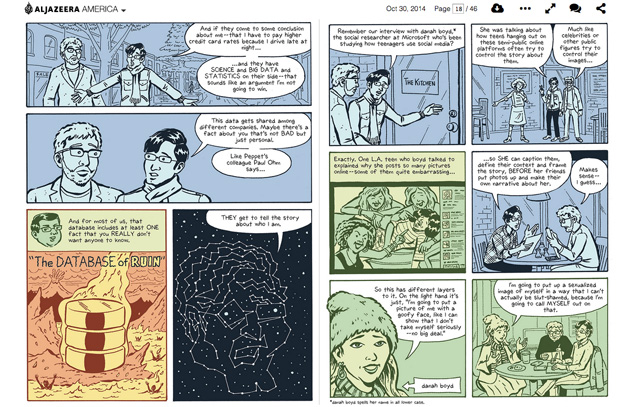
“Big Data powers the modern world. What do we gain from Big Data? What do we lose? Al Jazeera America examines the role of technology and the implications of sharing personal information in the network’s first graphic novella….New products and technologies like Gmail are often shocking (it scans your emails for keywords that it uses to show you ads) but then become more normal over time.

Sketch Guy: Personal Finance on a Napkin
 In this series of back-of-the-napkin drawings and posts, Carl Richards, a financial planner, explains the basics of money through simple graphs and diagrams.

This is an innovative take on the action-packed journey to the 2012 election done in graphic novel form.
NYTimes en Espanol – Me vetaron en Venezuela por reportar su realidad


Audio
We will focus on unique digital uses of audio, rather than traditional radio reporting, using audio snippets, raw audio, interactive tools.
Q&A
New Yorkers Speak Out on Stop, Question and Frisk Policy

Raw – ATC recordings
Flight 1549 – “We’re going to be in the Hudson.”
Some audio is so compelling, shocking, or unique as in the case of eyewitness testimony, 9-11 calls, and cockpit recordings that it can really place listeners at the scene.
Interactive audio


Audio slideshows
Lost and Found
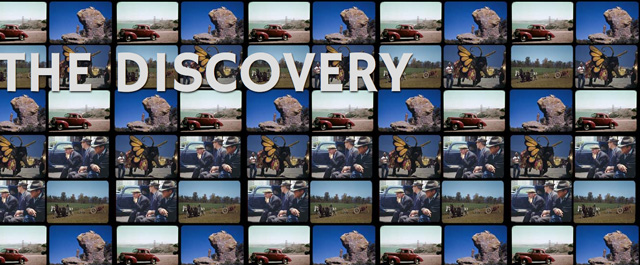 This animated NPR feature tells the story of the discovery of Charles Cushman’s color photography from the 1930s.
Podcasts

Video
Full-screen, modular vignettes, interactive, collaborative, crowd-sourced, user-generated, live, raw, streamed, annotated, 360 and geolocated
 After breaking the NSA surveillance story, The Guardian produced an in-depth multimedia piece.
Full-screen

“Luge is often the fastest event in the Olympics — so fast that track designers for Sochi tried to slow it down.” — NYTimes.com
Super-short/Animations

In this feature about the challenges of signing science terminology, 5-10 second video clips of an ASL interpreter accompany a longer 3-minute piece.

Interactive
These videos are “interactive” in the sense that the user is a character in the story or decides the course of events.

Can You Make It in the Gig Economy

Time-Lapse
Barcelona GO! from Rob Whitworth on Vimeo.
Geo-tagged
A Bear’s Eye View of Yellowstone


In this scrolling multimedia piece, short looped videos activate automatically when the viewer scrolls past. The 30-60 second clips are mixed in with still photography and geotagged to the map running alongside it.
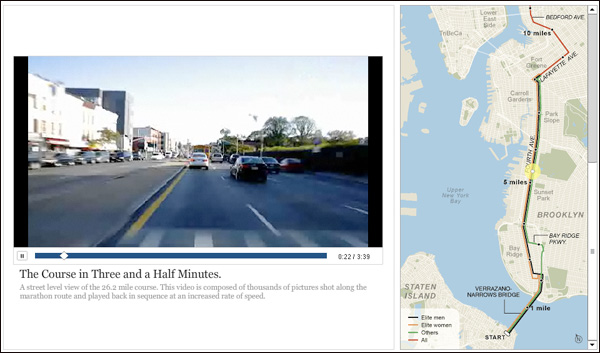
NYT – Time Lapse of NYC Marathon
360 Video

Fight for Fallujah
Seeking Pluto’s Frigid Heart
Social video


Augmented Reality: David Bowie in Three Dimensions

Interactive Graphics, Data Visualization
“Static visualizations have long been used to support storytelling, usually in the form of diagrams and charts embedded in a larger body of text. In this format, the text conveys the story, and the image typically provides supporting evidence or related details. An emerging class of visualizations attempts to combine narratives with interactive graphics. Storytellers, especially online journalists, are increasingly integrating complex visualizations into their narratives.”– Narrative Visualization: Telling Stories with Data
Online data visualizations include interactive infographics, maps and timelines. They are used to illustrate stories in geographical space and over time. Often, interactive infographics explain very complicated concepts in a very compact amount of space.


Fractions of a Second: An Olympic Musical
At the Olympics, the blink of an eye can be all that separates the gold medalist from the 10th-place finisher. In some events, this is obvious. But in others, with athletes racing one by one, the closeness of the race is harder to perceive.


The Language of the State of the Union

“An interactive chart reveals how the words presidents use reflect the twists and turns of American history.” – Atlantic Monthly
Workers’ Comp Benefits: How Much is a Limb Worth?

“If you suffer a permanent injury on the job, you’re typically entitled to compensation for the damage to your body and your future lost wages. But depending on the state, benefits for the same body part can differ dramatically.”
Interactive Tools
The Best and Worst Places to Grow Up: How Your Area Compares

“Children who grow up in some places go on to earn much more than they would if they grew up elsewhere.” — NYTimes.com

“The choice between buying a home and renting one is among the biggest financial decisions that many adults make. But the costs of buying are more varied and complicated than for renting, making it hard to tell which is a better deal. To help you answer this question, our calculator takes the most important costs associated with buying a house and computes the equivalent monthly rent.” — NYTimes.com
Datamining

It is often said that ‘information wants to be free,’ but it is even truer in the digital age that information wants to be analyzed, shared, synthesized, curated, aggregated, commented on and distributed. — Journalism Next, Mark Briggs
The Internet and social networks have opened up countless new ways for journalists to take the pulse of the nation and world. While aiming to avoid invasions of privacy, content on sites such as Facebook, Twitter and even Craigslist can be used to tell stories.


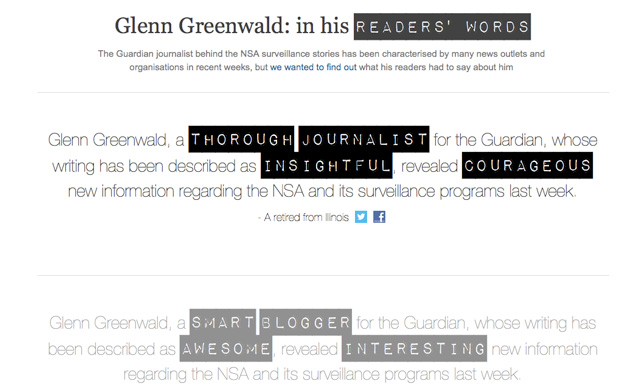
Glenn Greenwald: in his readers’ words
Top World Cup Players on Facebook Day to Day

The 258 People, Places and Things Donald Trump Has Insulted on Twitter: A Complete List


Gizmodo: Almost None of the Women in the Ashley Madison Database Ever Used the Site

“What I discovered was that the world of Ashley Madison was a far more dystopian place than anyone had realized. It isn’t even a sadscape of 31 million men competing to attract those 5.5 million women in the database. Instead, it’s like a science fictional future where every woman on Earth is dead, and some Dilbert-like engineer has replaced them with badly-designed robots.” — Annalee Newitz
Mapping Stories
Where American Men Aren’t Working

“It’s vastly more common today than it was decades ago for prime-age men not to be working. Across the country, 16 percent of such men are not working, be they officially unemployed or outside of the labor force — disabled, discouraged, retired, in school or taking care of family. That number has more than tripled since 1968.” — NYTimes.com

“America is being watched from above. Government surveillance planes routinely circle over most major cities — but usually take the weekends off.”

“In 50 years, most of southeastern Louisiana not protected by levees will be part of the Gulf of Mexico. The state is losing a football field of land every 48 minutes — 16 square miles a year — due to climate change, drilling and dredging for oil and gas, and levees on the Mississippi River. At risk: Nearly all of the nation’s offshore oil and gas production, much of its seafood production, and millions of homes.” — ProPublica

A Rogue State Along Two Rivers

“The militant group called the Islamic State in Iraq and Syria, or ISIS, seemed to surprise many American and Iraqi officials with the recent gains it made in its violent campaign to create a new religious state. But the rapid-fire victories achieved over a few weeks in June were built on months of maneuvering along the Tigris and Euphrates Rivers.”

Quizzes, Polls, Games
Which Terrifying Political Voice Said It?

Executioners vs. Veterinarians
“The Marshall Project compared two ways this country legally dispenses death: the execution of death-row prisoners and the euthanizing of incurably sick dogs and cats. See if you can guess which rules apply to which category of condemned creature.” — The Marshall Project


TrumpInsulter
Feeling left out that Trump hasn’t gotten around to insulting you or your friends? Here’s an app for that. Built on the real-live insults taken from the would-be President’s Twitter feed, @RealDonaldTrump, the generator below provides a Trump insult for everyone.


Collaborative: Crowd-sourcing & User-generated Content
Some of the most popular sites on the web today are those built by user-generated content: Wikipedia, YouTube, Flickr, Yelp, Vimeo, Instagram, SoundCloud, Pinterest. User-generated content means that some portion of the media is created by the user/viewer/reader.
The internet and cell phone users have turned news into a social experience. In this new multi-platform media environment, people’s relationship to news is becoming portable, personalized, and participatory.
Increasing numbers of internet users contribute to the creation of news, commented about it, or disseminated it via postings on social media sites like Facebook or Twitter.
News organizations are utilizing content from users for a wide range of purposes:
- To document a live or breaking news event, “eye-witness” or opinion
- To search for sources of information, story subjects or ideas
- To provide coverage from distinct perspectives
- To connect families during times of emergencies
- To take the pulse of the general public on a topic

Even in noisy New York, pockets of peace exist. The NYT asked readers to submit their favorite quiet spots in the noisy city.
Political Ads
 Interactive Documents
William Shakespeare, Playwright and Poet, Is Dead at 52

What might President Obama’s 2015 State Of The Union address mean for California?

20 key findings about CIA interrogations

“Almost 13 years after the CIA established secret prisons to hold and interrogate detainees, the Senate Intelligence Committee released a report on the CIA’s programs listing 20 key findings.” — Washington Post
Multiplatform
News Apps


News 360




HTML/CSS

- HTML to define the content of web pages
- CSS to specify the style and layout of web pages
- JavaScript to program the behavior of web pages

Analytics, SEO & SMO
Understanding User Behavior
Pew Research 2017
More than eight-in-ten U.S. adults now get news on a mobile device (85%), compared with 72% just a year ago and slightly more than half in 2013 (54%).


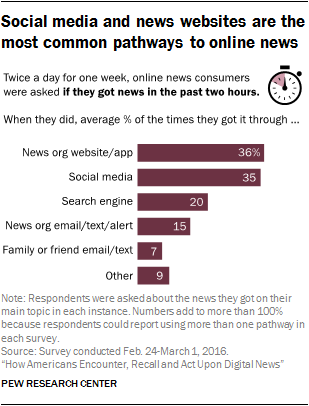
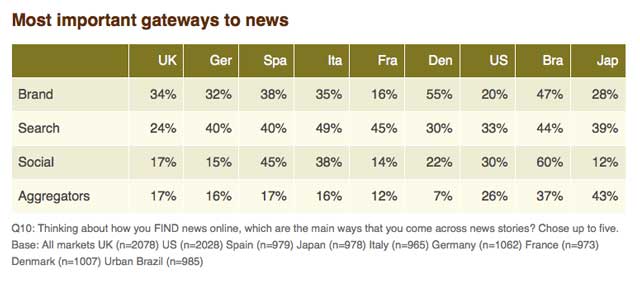
 Source: State of the News Media 2016
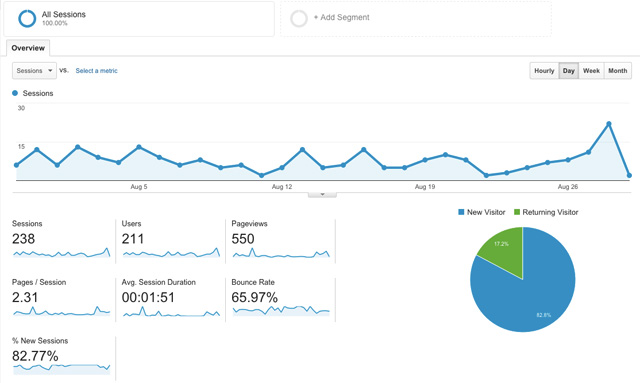
Google Analytics
Design Principles


From rainforest to your cupboard: the real story of palm oil
 “You wash with it, you brush with it, you toast it, it’s in 50% of what you buy – but what’s the real story of palm oil? ” — Guardian
